
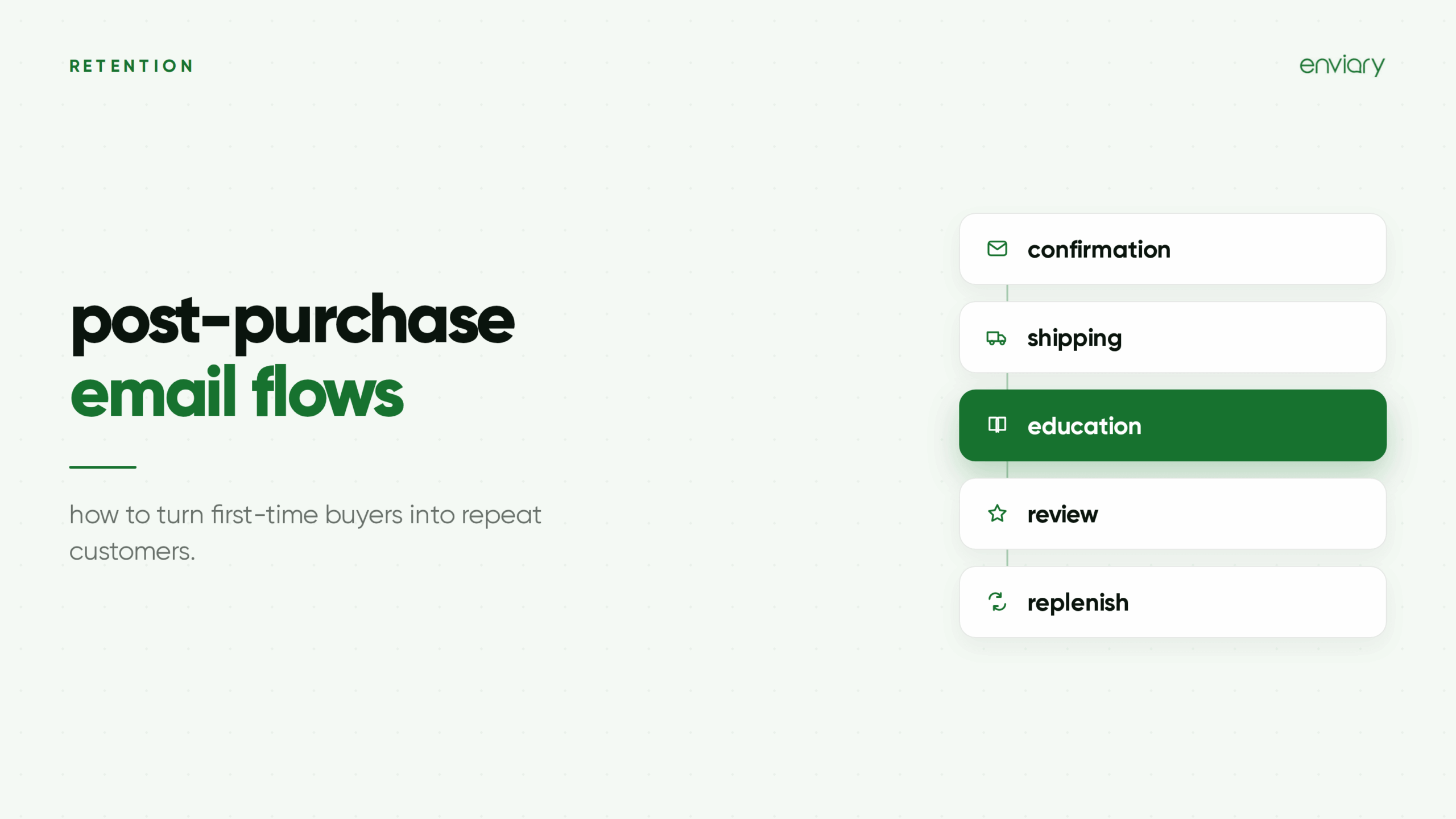
Ask most ecommerce teams to describe their post-purchase flow, and they will describe the emails they set up two years ago and have not opened since. A confirmation, a shipping notification, and somewhere in the account, a review request that may or may not still be firing.
It technically exists. It is almost certainly costing them repeat orders anyway.
The gap between a post-purchase flow that exists and one that actually drives second orders is not about adding more emails. It is about the specific, unglamorous things that go wrong once the flow is live and real customers are moving through it. Here is what those things are.
What is a post-purchase email flow?
A post-purchase email flow is the automated sequence of emails a customer receives after placing an order. It can include transactional messages such as order and shipping confirmations, as well as retention-focused messages such as product education, review requests, cross-sells and replenishment reminders.
The important distinction is that not every post-purchase email has the same job.
A confirmation reassures the customer that the order went through. A shipping update tells them what is happening with their parcel. An education email helps them get the result they bought the product for. A review request asks for feedback once they’ve had enough time to form an opinion. A replenishment email gives them a timely reason to buy again.
Treating all of those messages as one generic automation is where things start to break.
The best post-purchase email flows are built around what the customer actually needs at each stage of the journey, not around an arbitrary sequence of delays.
The post-purchase email flow: what to send and when
There is no universal sequence that works for every ecommerce brand. A customer buying a £20 cleanser has a different post-purchase journey from someone buying a £2,000 sofa.
But the underlying structure is consistent:
Stage
Main purpose
Order confirmation
Reassure and confirm
Despatch update
Set expectations
Delivery confirmation
Confirm the order has arrived
Product education
Help the customer succeed
Review request
Capture feedback and social proof
Cross-sell
Recommend something relevant
Replenishment
Prompt the next purchase at the right time
Loyalty / referral
Give customers a reason to stay
Win-back
Re-engage customers who go quiet
The mistake is thinking every customer should receive every message. They shouldn’t.
A first-time buyer may need a welcome and education sequence. A repeat customer may need less explanation and more recognition. A customer who has already reordered should exit the original post-purchase flow altogether. The logic matters as much as the copy.

Order Confirmation Emails: Your First Post-Purchase Retention Opportunity
Order confirmation emails are typically among the highest-opened emails a store sends, because customers are actively expecting them. Everyone knows this. Almost nobody acts on it.
What actually happens in most accounts is that the confirmation is owned by the platform, not the marketing team. It fires from Shopify or the checkout with default styling, default copy, and no thought, because it is filed mentally under “operations” rather than “retention.” So the single highest-attention moment you will ever have with a customer is spent on a plain receipt.
The fix is not to cram a sales pitch into it. Customers came for confirmation and will resent a hard sell at that moment. To turn the confirmation into a retention asset without overloading it:
- move ownership of the email from the operations or dev setup to whoever owns retention
- keep the order details exactly as clear as they were, since that is what the customer opened it for
- add one line that reassures them the purchase was a good decision, nothing more
- set the sending identity and reply-to to a monitored address, so a reply reaches a person
The intended effect is fewer anxious “where is my order?” support tickets and a more reassuring opening to the relationship.
Product Education Emails: Help Customers Get More from Their Purchase
When a flow is built under time pressure, the education email is always the first casualty. It feels optional next to confirmations and cross-sells. It is the one that quietly determines whether the product succeeds.
Here is the pattern that shows up again and again in real accounts. A customer buys, the product arrives, they use it wrong or use it once and forget, it underdelivers through no fault of the product, and they never reorder. The brand records this as a product problem or a market problem. It was a communication problem. Nobody told the customer how to get the result they bought the product for.
A serum applied in the wrong order. A supplement taken irregularly so it never reaches its effect. A garment washed in a way that ruins it by month two. Every one of those is a lost repeat order that a single well-timed email would have prevented.
A useful education email answers three questions and nothing else:
- how do I use this correctly, in the fewest possible steps
- what result should I expect, and by when
- what is the one mistake that stops it working
If a brand is going to add one message to its flow, this is the one with the highest return and the one most likely to be missing.
Replenishment Emails: Match Reminders to Product Consumption
For any consumable product, the reorder reminder is the most profitable message in the flow. Most brands either do not run one or run it on a round number that has nothing to do with the product.
A thirty-day supply gets a “time to reorder” email at exactly thirty days, which sounds right and is slightly too late, because the customer ran out two days ago, felt the gap, and may have already bought a competitor’s product off a search result. Or the interval is set to a generic sixty days across an entire catalogue of products with completely different consumption rates.
The work here is boring, and it is where the money is:
- find the genuine consumption cycle for each product, not one interval for the whole catalogue
- set the reminder to land a little before the customer runs out, not on the day the supply theoretically ends
- segment by product where consumption rates differ sharply, so a fast-use item and a slow-use item are not on the same timer
- suppress the reminder if the customer has already reordered, so nobody is nudged to buy what they just bought
Done this way, the email stops feeling like marketing and starts feeling like a service the customer is glad to receive. This is one of the closest ways a non-subscription brand can create more predictable repeat revenue.

Why Post-Purchase Discounts Can Damage Retention
There is a decision every brand makes early in a post-purchase flow, usually without realising it is a decision. Whether to put a discount in the thank-you email.
It is tempting because it appears to work. Send “thanks for your order, here is fifteen per cent off your next one”; some people use it, the flow shows revenue, and everyone moves on. What the number does not show is the customers who would have reordered at full price and now never will, because you have taught them that a code is always coming. A brand that discounts every new customer by default is not running a retention flow. It is running a slow, permanent margin cut with a retention flow’s name on it.
The harder and better route is to earn the second order without the crutch: the product delivered well, the experience that felt considered, the education that made it work. Keep the discount for a specific job, such as reactivating a genuinely lapsed customer, rather than spending it on people who were going to come back anyway. The brands with the healthiest repeat rates are usually the ones most disciplined about when they do not discount.
First-Time vs Returning Customers: Why the Flow Should Change
One of the easiest improvements to make to a post-purchase flow is to stop treating every buyer as the same buyer. A first-time customer has different needs from someone who has purchased five times. Klaviyo specifically recommends branching post-purchase flows based on factors such as whether someone is a new or returning customer and how much they have spent.
At minimum, consider separating:
First-time customers
Focus on:
- welcome
- brand introduction
- product education
- support
- review request
- relevant next purchase
Returning customers
Focus more on:
- recognition
- loyalty
- early access
- complementary products
- replenishment
- VIP treatment
High-value customers
Consider:
- VIP access
- loyalty rewards
- exclusive products
- referrals
- personal customer service
Customers who have returned or refunded
Don’t continue sending the standard “hope you’re enjoying your purchase” sequence.
Change the journey.
The more relevant the flow becomes, the less work each email has to do.
Audit and Maintain Your Post-Purchase Email Flows
The defect underneath all the others is that post-purchase flows are treated as setup, not as a system that is maintained. They get built once, switched on, and left. Products change, delivery times change, the catalogue grows, and the flow keeps sending the assumptions of eighteen months ago.
A review request still points to a product that has been discontinued. An education email describes a formula that has been reformulated. A cross-sell recommends an item that is permanently out of stock. None of it is visible from the dashboard, because the flow is “live” and the open rates look fine.
The only reliable way to catch it is a review you run yourself, twice a year:
- place a real order and move through the entire flow at real timing, not a preview
- check every product referenced is still in the catalogue and still described correctly
- confirm every link resolves and every discount code still works
- read each email on a phone, where most of your customers will see it
Almost nobody does this, which is precisely why doing it is an advantage.
How to Measure Post-Purchase Email Flow Performance
Ignore the vanity of a flow’s total attributed revenue, which only ever goes up and tells you nothing about whether it is working. The numbers that matter are narrower:
- repeat purchase rate of each monthly cohort at thirty, sixty, and ninety days, because that is the number the flow exists to move
- time between first and second order, because it tells you whether your reminders are landing early enough
- repeat rate split by product and by acquisition channel, because the averages hide where the real loyalty is coming from
And walk the flow yourself, in real time, before you trust any of it.
A post-purchase flow that has not been reviewed in the last six months is not an asset. It is a set of assumptions still being emailed to your best customers. The brands that win repeat orders are not the ones with the most emails. They are the ones who treat the flow as something that is maintained, timed to real events, and honest enough not to bribe a customer who was already coming back.