BFCM email segmentation is one of the biggest factors separating high-performing ecommerce brands from those that simply send one discount to everyone.
It feels efficient. It isn’t. It’s the most expensive email you’ll send all year – and the cost doesn’t show up on the revenue line. It shows up in the margin you gave away to people who’d have paid full price, and in the subscribers who left because the message had nothing to do with them.
Your customers are not one audience. A first-time visitor who found you through a Black Friday Google search and a VIP who’s bought from you eleven times are not the same person, don’t want the same thing, and shouldn’t receive the same email. Treating them as one list is the single most common way brands underperform during the one weekend they can least afford to.
That’s what BFCM segmentation actually fixes: sending the right message to the right customer at the right moment, instead of one message to everyone. The data backs it plainly – Klaviyo’s analysis of billions of sends found that the unsubscribe rate for unsegmented campaigns runs at twice that of highly segmented ones. During BFCM, when send volume triples and every inbox is at breaking point, that gap is the difference between a list you keep and a list you burn.
Personalisation is not a first
Before the segments, one thing worth clearing up because it’s where most brands go wrong.
Putting “Hi Sarah” at the top of a batch-and-blast isn’t personalisation. It’s a mail merge with better manners. Sarah still receives the same offer, at the same time, with the same ask as the ninety thousand people behind her.
Real segmentation changes four things at once: who receives the message, what they see inside it, when it lands, and what you ask them to do. Get those four right, and you never need Sarah’s name in the subject line, because the whole email already reads as though it was built for her. That’s the standard to hold every segment below against.
Segment by behaviour, not demographics
Age, gender, and location tell you who someone is. They tell you almost nothing about whether they’re about to buy.
Behaviour tells you what someone has purchased, how recently, how often, what they’ve browsed, what they left in a cart, whether they’ve opened your last ten emails or none of them. That’s the data that predicts a BFCM purchase, and it’s the data your segmentation should run on. Demographics are a weak proxy for intent. Behaviour is intent.
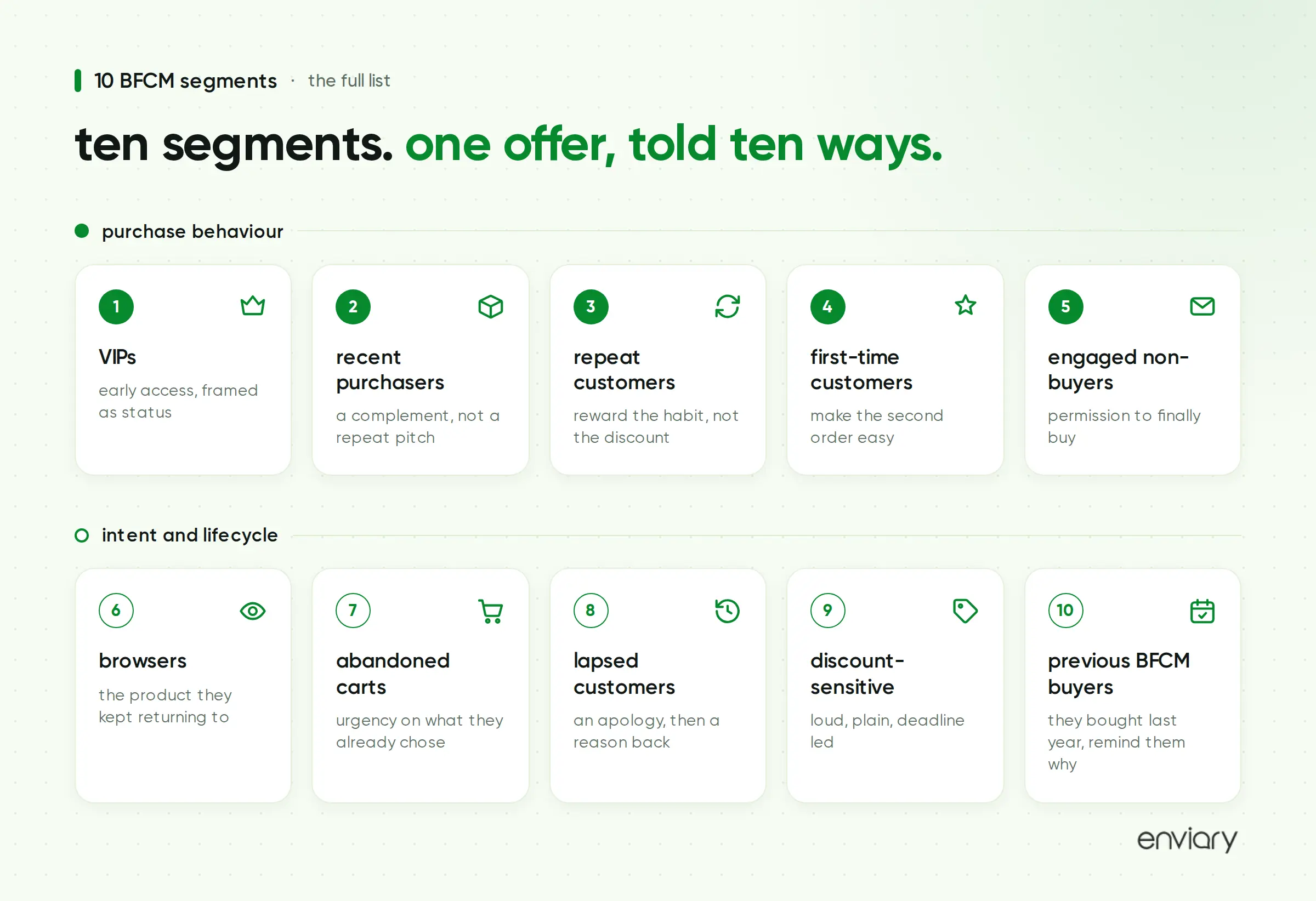
So here are the ten customer segments worth building before the weekend, what each one needs to hear, and the mistake to avoid with each.
1. VIPs and high-value customers
Your top 5–10% by spend. They’ll buy during BFCM regardless, which is exactly why they need handling with care: a public discount to this group is margin you didn’t need to spend.
Give them something the discount hunters don’t get: early access, a genuinely better offer, first pick before stock thins. Klaviyo’s own BFCM guidance is to email your VIPs between Tuesday and Thursday before Black Friday, ahead of the crowd, and it’s the right instinct: reach them before the inbox war starts.
What to avoid: treating them like everyone else. A VIP who realises they got the same email as a first-time bargain hunter, at the same time, learns their loyalty buys them nothing- an expensive lesson to teach your best customers.
Framed for them: “You’re on the list first. 25% off, twenty-four hours before everyone else.”
2. Recent purchasers
Bought in the last 30 days. The trap here is obvious once you see it: blast this group a 25%-off-everything email, and you’ve just told someone who paid full price last Tuesday that they overpaid. That’s a refund request or a resentment, not a sale.
Don’t lead with the discount. Lead with the complement to the accessory to what they bought, the next product in the sequence, the thing that makes their purchase better. Cross-sell, don’t re-sell.
Framed for them: “You bought the jacket. Here’s 20% off the boots that go with it.”
3. Repeat customers
More than one order, not yet VIP. These are your growing relationships, the people one nudge away from becoming your best customers. They’ve proven they’ll come back; BFCM is when you accelerate it.
Acknowledge the relationship. Reward the loyalty. Show them you know they’ve been here before. A mid-tier perk or a loyalty bonus works harder on this group than a flat discount, because it moves them up rather than just moving stock.
Framed for them: “Your third order deserves something. Here’s early access and double points.”
4. First-time customers
Bought once, during or just before BFCM. This is the whole ball game: a first-time BFCM buyer is either a customer you keep or a discount tourist who never returns, and which one they become is decided in the days after the sale, not during it.
Welcome them properly. The priority isn’t a second discount; it’s a second reason to care: what your brand stands for, what to expect, why the first purchase was a good decision. The sooner they’re inside a proper welcome sequence, the higher the odds they come back in January.
What to avoid: silence. The brand that says nothing after the first order has taught a new customer that they were a transaction.
Framed for them: “Glad you found us. Here’s what to expect, and a little something for next time.”
5. Engaged non-buyers
On your list, opening your emails, clicking and never buying. They’re interested. Something’s stopping them, and BFCM removes the most common something, which is price.
This is the group a discount is genuinely built for. They’ve done everything except convert, and the seasonal offer is the permission they’ve been waiting for. Make it clear, make it time-boxed, and make the path to purchase short.
Framed for them: “You’ve been keeping an eye on us. Now’s the moment – 25% off, ends Sunday.”
6. Browsers and window shoppers
Visited during the BFCM window, browsed, didn’t buy, may not even be subscribed. High intent, no commitment. Klaviyo suggests grouping shoppers who browsed your site during the BFCM window but never purchased as a segment in its own right – worth the effort, because these people were this close.
Show them what they looked at. Remind them it’s still there, still discounted, not for long. Specificity beats generality here: the product they viewed, not your homepage.
Framed for them: “Still thinking about it? It’s 25% off until midnight.”
7. Abandoned carts
Added to cart, didn’t check out – the highest-intent group you have. They chose the product, they started paying, something interrupted. During BFCM, that something is usually the eleven other tabs they had open.
Remind them what they left, apply the offer to it, and add a clean deadline. This is where urgency is fully earned, because the intent is already proven. Don’t overthink the creative; the product and the price do the work.
Framed for them: “Your cart’s still here. 25% off applied. It expires tonight.”
8. Lapsed customers
Bought before, gone quiet, 90 days or more. BFCM is the best win-back window of the year. The one thing that reliably reactivates a lapsed customer is a reason good enough to come back, and your biggest offer of the year is exactly that.
Lead with “we miss you,” not “buy now.” Acknowledge the gap. Make the offer strong enough to justify the return trip. This is one of the few moments a genuinely aggressive discount to a lapsed segment pays for itself.
What to avoid: pretending they never left, and dropping them into your standard BFCM flow. They need a different first line.
Framed for them: “It’s been a while. Here’s our best offer of the year to bring you back.”
9. Discount-sensitive customers
The deal hunters. They buy on price and wait for sales – Klaviyo profiles them plainly as shoppers who are only willing to shop sales or perceived deals, motivated to save money, and often willing to stock up if it means saving in the long run.
There’s no shame in serving this group, but serve them knowingly. This is where you point your steepest, loudest discount, because it’s the only thing that moves them, and you’re not sacrificing margin you’d have captured anyway. The mistake is letting this offer leak to everyone else. A discount built for deal hunters, sent to your whole list, trains your entire base to wait for the next sale.
Framed for them: “The biggest discount we do all year. Stock up now.”
10. Previous BFCM buyers
Bought during last year’s Black Friday, quiet since. A specific and valuable pattern: these are seasonal buyers, people who show up for the sale and may not engage the rest of the year. That’s not a problem to fix; it’s a rhythm to work with.
Reference the pattern gently. They came last year, the sale’s back, here’s what’s new. You already know they convert at this time of year, so the job is simply to be in front of them when the window opens.
Framed for them: “You shopped our sale last year. It’s back, and it’s bigger.”
The same 25%, ten different emails
Notice what just happened. Every segment above can be sitting on the same underlying offer – 25% off – and not one of them receives the same email.
The VIP gets it early and framed as status. The recent buyer gets it attached to a compliment. The engaged non-buyer gets it as permission. The lapsed customer gets it as an apology. The deal hunter gets it loud. The discount didn’t change. Who received it, what they saw, when it landed, and what they were asked to do changed completely.
That’s the entire discipline in one line: segmentation isn’t ten discounts; it’s one offer, told ten ways, to ten relationships. And it’s why a segmented BFCM programme earns more on the weekend and keeps more of the list afterwards, which is the part that actually compounds.
P.S. - a note on not overdoing it
Before you go and build thirty segments: don’t.
The brands that win at this build three to five that matter and run them cleanly, rather than twenty that overlap and never get measured. Start with VIPs, abandoned carts, engaged non-buyers, and lapsed customers; those four carry most of the upside. Add the rest once the first ones are earning.
And make your purchase-state segments mutually exclusive, so a recent buyer isn’t also sitting in your discount-hunter blast receiving two contradictory emails an hour apart. Suppression is as much a part of segmentation as sending.
Conclusion
The batch-and-blast BFCM email treats your whole list like strangers who happen to share an inbox. Segmentation treats them like what they actually are: VIPs and newcomers, loyalists and lapsed, buyers and browsers, each at a different point in their relationship with you.
That reframing is the point. BFCM, run well, isn’t a weekend where you extract maximum revenue from a single list. It’s a weekend where you strengthen ten different relationships at once, so the list is worth more in March than it was in October.
The same discount for everyone is the easy email. Want to see what the segmented version looks like for your brand? Book a call or reserve your BFCM revenue kit, and let’s build your BFCM segments before the rush.