Every year, it’s the same. Black Friday ends, the revenue figure lands in the team Slack, someone adds a rocket emoji, and everyone celebrates. Record BFCM sales. Another successful year.
Except that number doesn’t tell you whether your Black Friday was actually a success.
Revenue tells you what the weekend earned. It doesn’t tell you what those customers are worth. A brand that generated £200,000 from one-time bargain hunters who never returned had a weaker BFCM than one that generated £120,000 from customers who came back in February, April and July. The first bought revenue. The second built customers.
That’s where most brands get it wrong. They pour their budget into acquisition, obsess over ROAS, and celebrate the sales weekend. Then the customer receives an order confirmation, a shipping email, and silence.
Yet Klaviyo’s BFCM reporting consistently shows that returning customers are a major driver of ecommerce revenue, underlining a simple truth: Black Friday is when you acquire customers. Retention is when you make money.
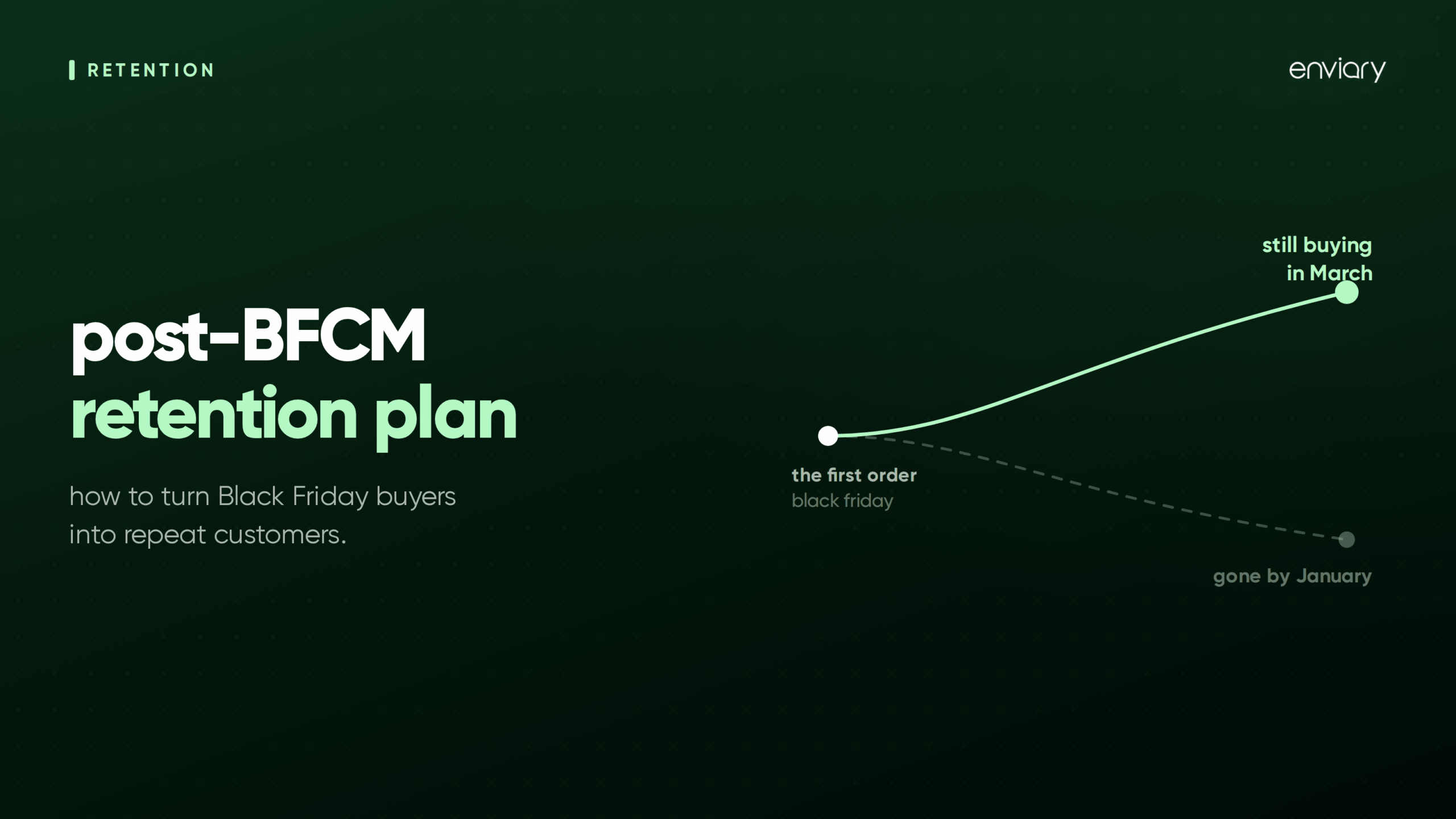
The real measure of BFCM isn’t what happened over four days in November. It’s how many of those customers are still buying from you three months later.
That’s what this article is about. Because after the sale, every Black Friday buyer either becomes a loyal customer or disappears.
The discount trap: Why post-purchase discounts hurt retention
The reflex post-purchase email is “thanks for your order, here’s 20% off your next one.” It feels generous. It’s actually damaging: you’ve just taught a brand-new customer that the only reason to buy from you is a discount, before they’ve even received the first order. Do that at BFCM scale, and you build a base that only buys on sale, then wonder why margins are thin every month that isn’t November.
A retention strategy gives people a reason to return that isn’t a discount: a product they love, an experience that felt considered, a brand worth hearing from. The discount can come later, aimed and deliberate, not your opening line.
1. The order confirmation
The moment after checkout is the highest-attention window you’ll get with a customer. The order confirmation earns the highest open rate of any email you send, so make it more than a receipt: reassure them, hint at what’s coming, make them feel they’ve joined something.
Set expectations plainly too: when it ships, when it arrives, what to do if something’s wrong. A BFCM buyer often knows little about your brand beyond the discount; Klaviyo recommends dedicated post-purchase flows for these customers that introduce your brand gradually rather than assuming they already care. Clarity here prevents anxious “where’s my order” emails and builds the trust a second purchase needs.
2. Shipping updates
BFCM is peak season, and peak season is when delivery goes wrong. A customer left in the dark during the wait won’t return, regardless of how good the product is.
Proactive updates (packed, shipped, out for delivery) are retention work disguised as logistics. Each one lowers the odds of a refund or complaint. SMS earns its place here: delivery is exactly the time-sensitive, glance-and-go message the channel was built for.
3. Product education
A customer who knows how to use a product well is one who keeps it, reviews it warmly, and buys again. This is the most underused email in e-commerce.
How to use it, care for it, get more from it: a skincare brand on application order, a coffee brand on the grind, a clothing brand on washing. Education prevents the quiet killer of retention: a product that underwhelms simply because it was used wrong.
4. Review requests
A well-timed review request does double duty: social proof for future shoppers, and re-engagement at the moment a customer is happiest.
Timing matters. Asking before delivery gets a frustrated non-answer, so wait until they’ve had time to form a view. Frame it as wanting their opinion, not extracting a testimonial. People can tell the difference.
5. Cross-sell
Now, and only now, point them at what’s next. Someone who bought once is far more likely to buy again than a stranger is to buy for the first time. The second purchase is the turning point the relationship hinges on.
The key is relevance over reach: not “here’s everything we sell,” but “here’s what goes with what you bought.” Personalised recommendations built on the actual purchase convert far better than a generic catalogue blast, because they read as help, not selling.
6. Replenishment timing
If you sell anything consumable, this is likely your highest-return flow, and it’s almost entirely automatable. Someone bought a thirty-day supply thirty days ago and is about to run out. An email that arrives at exactly that moment isn’t marketing; it’s a favour, and it converts like one.
Match the reminder to the product’s real consumption timeline, not an arbitrary interval, and the message writes itself.
7. Loyalty
Somewhere in here, the relationship should start to feel rewarded, not just through a points programme, but through the sense that this brand notices returning customers and gives them reasons to stay beyond price.
This is exactly what the BFCM 2025 data pointed to: repeat customers spent more not because of bigger discounts, but because of early access, exclusive drops, and VIP treatment. Loyalty turns a second purchase into a habit, and a habit into lifetime value.
8. Win-back campaigns
Not every BFCM buyer sticks, and that’s fine, as long as you have a plan for the ones who drift. A customer who bought in November and went quiet by March isn’t lost. They’re dormant.
Acknowledge the absence, remind them what they liked, and give them a reason to return that’s compelling without being desperate. This is one of the few places a sharper discount is justified: reactivating a lapsed customer is still cheaper than acquiring a new one.
9. Measuring what matters
You can’t improve what you don’t look at, and most brands never look past the weekend total.
Track these instead: repeat purchase rate of the BFCM cohort at 30, 60, and 90 days; customer lifetime value split between BFCM-acquired and regular customers, since top-performing brands measure the CLV gap between the two; time to second purchase; and the plain new-versus-returning split on the weekend itself.
Weak versus strong: the same customer, two futures
Here’s the compressed view of the whole article.
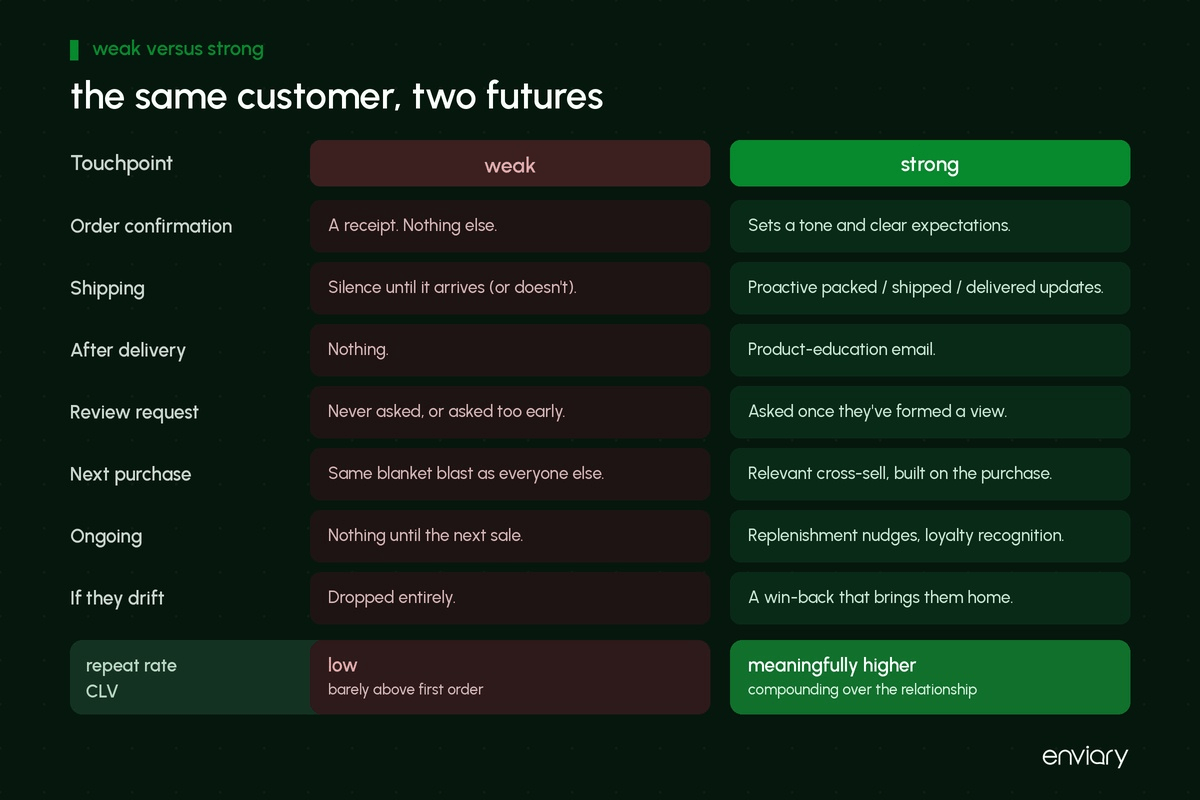
Same customer. Same first order. Completely different second year, not because of a bigger discount, but because of a sequence that treated the first purchase as a beginning, not a conclusion.
The next 90 days decide it
BFCM revenue is the easiest number to celebrate and the least useful one to stop at. The weekend acquires customers cheaply and at scale. What you do in the weeks after decides whether that was an investment or a one-off.
The brands pulling ahead have stopped asking “how much did we make this weekend” and started asking “how many of these people are still here in March.” That answer is written in the post-purchase flows you build before the sale, not after it.
Your Black Friday customers are your biggest retention opportunity of the year. Let us help you build the plan for what happens after the sale.