The Psychology Behind High-Converting Emails
High-converting emails don’t convince people to act. They make the decision feel easy, safe, and obvious.
Most email optimisation focuses on what to say: stronger CTAs, better subject lines, more urgency. But conversion isn’t driven by words alone. It’s driven by how the message aligns with the way people think, process information, and make decisions.
At Enviary, we treat email as applied behavioural psychology, quietly shaping decisions across the lifecycle, not chasing short-term clicks. This is the psychology behind emails that convert and retain.
This article breaks down the psychology behind emails that convert and retain and how those principles show up in real email programmes.
Why Most Emails Fail
The brain filters constantly. It ignores anything irrelevant, hard to process, or emotionally unsafe. Most emails fail for one simple reason: they're written from the brand’s perspective, not the customer’s.
Across Shopify and Klaviyo accounts, we consistently see three psychological breakdowns:
- Lack of relevance: Generic messages rarely engage. People respond to what reflects their behaviour, not their demographics.
- Cognitive friction: Confusing layouts, multiple CTAs, or conflicting messages create mental effort that reduces conversion.
- Erosion of trust: Overused urgency, manipulative language, or excessive volume damages credibility and retention.
When an email underperforms, it’s rarely because the offer was wrong. More often, it’s because the message created friction, be it mental, emotional, or contextual.
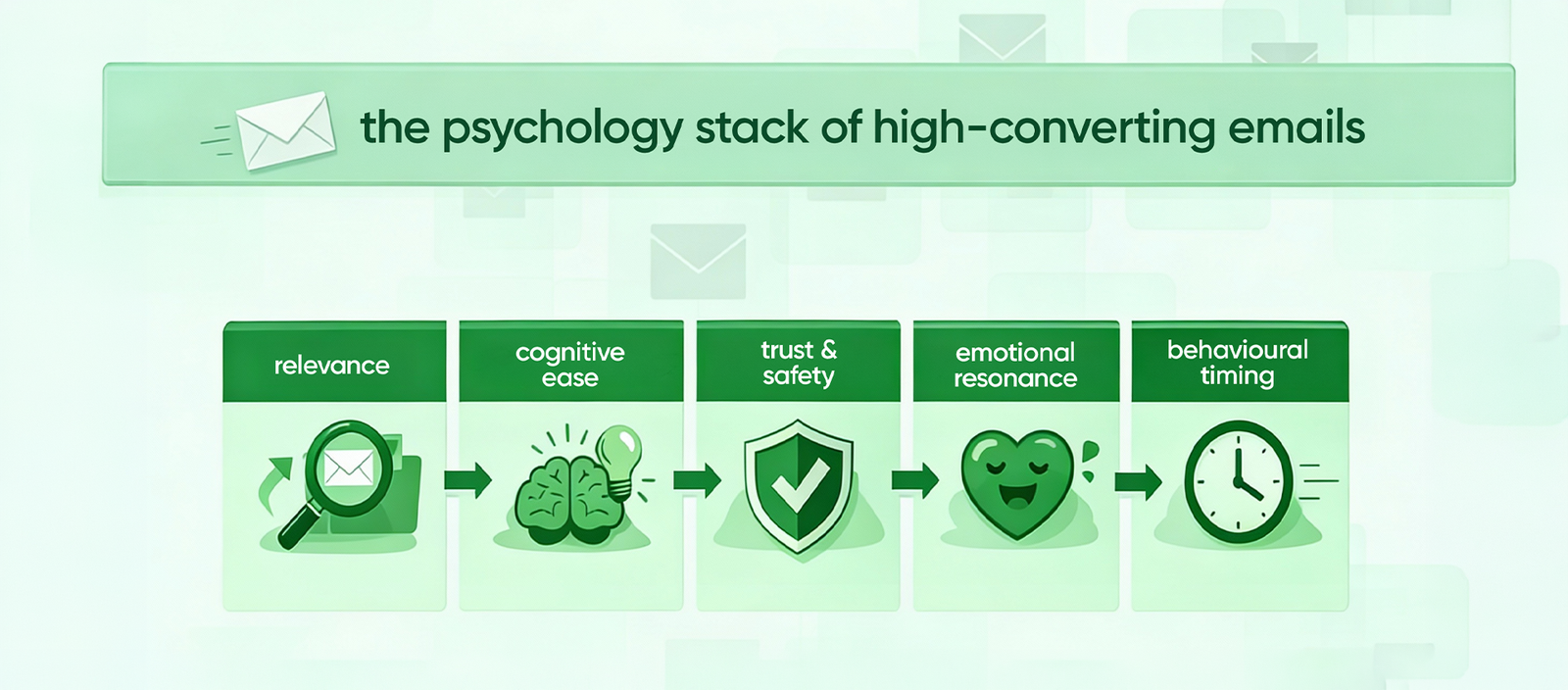
The Behavioural Alignment Framework (How High-Converting Emails Work)
High-performing email programmes consistently reduce friction before attempting persuasion. At Enviary, we anchor this in a simple behavioural model:
The Behavioural Alignment Framework
Relevance → Cognitive Ease → Trust → Emotional Safety → Timing
If any one of these breaks, conversion becomes harder, regardless of the copy quality.
1- Relevance: The Brain Only Engages With What Feels Personal
The brain filters aggressively. If a message doesn’t feel immediately relevant, it’s dismissed, often subconsciously.
This is rooted in selective attention: people notice what connects to their current context and ignore the rest.
Relevance isn’t:
- Using a first name
- Sending the same message to a broad segment
True relevance is behavioural. It reflects:
- What someone browsed
- What they purchased
- How recently they engaged
- Where they are in their lifecycle
Example in practice A customer who browsed a product three times but didn’t buy is in a different psychological state than someone who purchased once months ago, even if they sit in the same "segment".
Behaviour-led segmentation ensures emails mirror current intent, not historical labels. That’s why it consistently outperforms demographic or list-size thinking.
2- Cognitive Ease: Make the Decision Feel Simple
People prefer options that are easy to understand. This is known as cognitive fluency, the brain’s tendency to favour clarity over complexity.
In email, cognitive friction shows up as:
- Multiple competing CTAs
- Long, dense copy blocks
- Mixed messages (educational and promotional at once)
High-converting emails do less, not more.
They:
- Communicate one clear idea
- Guide one to the next step
- Remove unnecessary choices
Clarity reduces effort, and reduced effort increases action. This is why many “beautiful” emails underperform. They ask the reader to think too hard.
3- Trust & Safety: Conversion Requires Emotional Security
Every purchase decision carries risk. Even low-cost ones.
Psychologically, people need to feel safe before they act. That safety comes from consistency, predictability, and credibility, not pressure.
This is where many brands overuse urgency and unknowingly damage long-term performance.
Excessive urgency:
- Signals desperation
- Trains customers to wait for discounts
- Erodes perceived value over time
High-converting emails build trust quietly by:
- Setting clear expectations
- Reinforcing brand consistency
- Using social proof sparingly and honestly
- Avoiding manipulative language
4- Emotional Resonance: People Justify With Logic, Decide With Feeling
Even rational purchases are emotionally driven first. Logic follows to justify the choice.
This aligns with decades of behavioural research, including dual-process thinking: fast, intuitive decisions supported by slower rational validation.
Effective emails speak to emotional needs like:
- Confidence (“I’m making the right choice”)
- Relief (“This solves a problem I have”)
- Belonging (“This brand understands me”)
This doesn’t require hype or exaggeration. In fact, restraint often increases credibility.
The most effective emotional emails feel calm, human, and grounded because confidence is persuasive.
5- Timing: The Most Underrated Conversion Lever
An email sent at the wrong moment, even with a strong copy, will struggle.
Timing psychology is about readiness, not just schedules.
It considers:
- Recency of behaviour
- Purchase cadence
- Lifecycle stage
- Inbox fatigue
Sometimes the highest-converting decision is not to send yet.
We often see performance improve when brands reduce volume and align sends more closely with behaviour. Fewer emails with better timing gives stronger results.
Why Pressure-Based Emails Convert Less Over Time
Short-term conversion tactics, scarcity and urgency can work, but they decay quickly when overused.
Psychologically, constant urgency triggers habituation. What once felt special becomes background noise. Over time, customers disengage or only respond to deeper discounts.
Brands that rely heavily on pressure typically see:
- Declining engagement rates
- Lower repeat purchase frequency
- Reduced brand trust
Because sustainable conversion comes from alignment, not escalation.
Psychology Applied Across the Lifecycle (Where It Actually Matters)
The real impact of psychology shows up outside of campaigns.
Examples:
- Welcome emails that reassure instead of overwhelm
- Abandoned cart emails that reduce doubt, not induce guilt
- Post-purchase emails that reinforce confidence in the decision
- Loyalty emails that recognise behaviour, not just spend
When lifecycle emails are designed with psychological intent, conversion becomes a natural outcome, not a forced one.
What High-Converting Emails Don’t Do
Strong email programmes are defined as much by what they don’t do.
They avoid:
- Default urgency
- Over-sending
- Over-explaining value
- Chasing every possible click
Conversion without retention isn’t growth; it’s delayed churn.
Conclusion: Psychology Is the Quiet Advantage
High-converting emails aren’t louder. They’re calmer.
They respect attention, reduce effort and build confidence over time.
When email strategy is rooted in psychology, not pressure or shortcuts, you don’t just increase conversion. You build trust, loyalty, and compounding performance.
For founders and brand owners, this is where the real advantage sits. Not in louder campaigns or more urgency, but in understanding how customers actually think and behave.
At Enviary, we design lifecycle email systems around those behavioural principles, helping ecommerce brands turn email into a predictable, long-term revenue driver.
If you’d like to see how these psychological frameworks could improve the performance of your email flows and campaigns, you can book a strategy call with Enviary and explore where the biggest opportunities sit inside your current lifecycle marketing.
Ready to Scale?
Perfect Your Retention Marketing Strategy
Schedule your growth strategy call to discover how we bring the value to the table.
- Your current retention challenges
- Untapped revenue opportunities
- Strategic growth roadmap
- Clear implementation plan
- Untapped revenue opportunities